

You are here: Home State of Hawaii Finances Budget System

Budget System


Pursuant to the Executive Budget Act of 1970, the Planning, Programming and Budgeting System of the State was adopted.   The purpose of this act is to integrate the planning, programming and budgeting processes to improve decisions on the allocation of resources.   The act established a comprehensive system for State programs and their related costs over a time frame of six years.   The operating and capital improvement requirements are evaluated together to ensure compatibility and mutual support.   Systematic evaluations and analyses are conducted to ascertain the attainment of program objectives and alternative means or methods of improving current State services.   The act provides that the Director of Finance and the Governor may modify or withhold planned expenditures if such expenditures would be in excess of authorized levels of service or in the event that State receipts and surpluses would be insufficient to meet authorized expenditure levels.

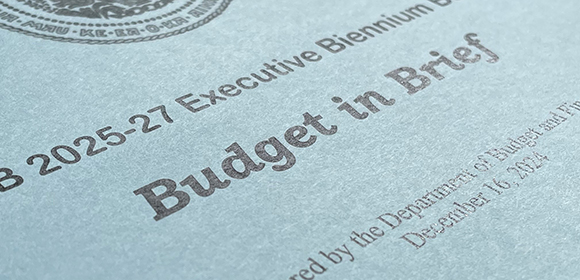
The act also provides that the Governor shall submit a six-year program and financial plan, budget, and program memoranda to the Legislature in each odd-number year.  The six-year program and financial plan and the budget are usually combined in a single document.  In addition, the Governor shall submit a variance report to the Legislature each year and may submit a supplemental budget in an even-number year.

The Legislature convenes annually in regular session on the third Wednesday in January.   Regular sessions are limited to a period of 60 days, and special sessions are limited to a period of 30 days.   Any session may be extended by no more than 15 days.   In not fewer than 30 days before the Legislature convenes in regular session in an odd-numbered year, the Governor shall submit to the Legislature the Governor's proposed State budget of the executive branch for the ensuing fiscal biennium.  

The budgets of the judicial and the legislative branches are submitted by their respective leaders to the Legislature for its consideration.   In a regular session, no appropriation bill, except bills recommended by the Governor for immediate passage, or to cover the expenses of the Legislature, shall be passed on final reading until the bill authorizing the operating expenditures for the executive branch for the ensuing fiscal biennium, to be known as the general appropriations bill, has been transmitted to the Governor.  

In each regular session in an even-numbered year, the Governor may submit to the Legislature a bill to amend any appropriation for operating expenditures of the current fiscal biennium, to be known as the supplemental appropriations bill.  In a session to which the Governor submits to the Legislature a supplemental appropriations bill, no other appropriations bill, except bills recommended by the Governor for immediate passage, or to cover the expenses of the Legislature, shall be passed on final reading until the supplemental appropriations bill has been transmitted to the Governor.   To become law, a bill must pass three readings in each house on separate days.

Each bill passed by the Legislature shall be certified by the presiding officers and clerks of both houses and thereupon be presented to the Governor.   If the Governor approves and signs the bill, it becomes law.   If the Governor does not approve a bill, the Governor may return it, with the Governor's objections, to the Legislature.   Except for items appropriated to be expended by the judicial and legislative branches, the Governor may veto any specific item or items in any bill which appropriates money for specific purposes by striking out or reducing the same;   but, the Governor shall veto other bills only as a whole.

Document Actions