

Hawaii Conservation Resource Enhancement Program
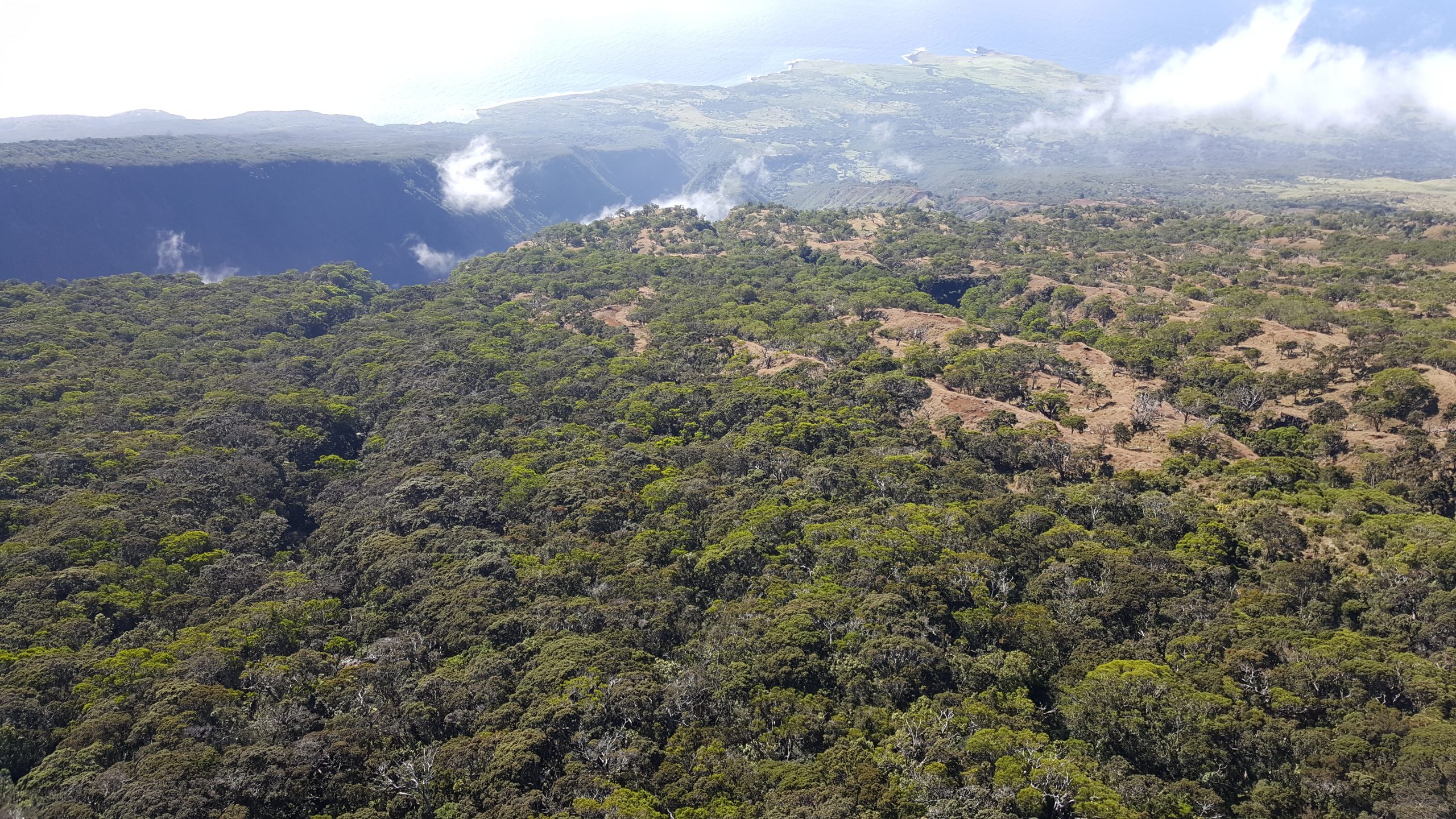
The project will restore riparian forest buffers, wetland buffers, and other reforestation sites by planting native vegetation and controlling invasive species. The primary goals of the project are to enhance wildlife habitat and control invasive species, as well as improve water quality and quantity, increase groundwater recharge, improve near shore coral reef health and diversity by filtering agricultural runoff and increasing water condensation in the uplands.
Benefits
Hawaii CREP will provide for restoration of previously forested, degraded agricultural land. The project will improve wildlife habitat through the creation of riparian forest buffers corridors and expansion of critical habitat for the many threatened, endangered, and rare species of Hawaii. This project will improve water quality and quantity by reducing soil runoff, increasing potential ground absorption, and reducing stream sedimentation and nutrient loading to near-shore environments. In addition, Hawaii CREP seeks to enhance coral reef habitat and increase diversity of associated aquatic species by decreasing the amount of run-off from the upland terrestrial environment.
GoalsThe goals of Hawaii CREP:
|
|
Eligibility
Landowners or lessees with land that is physically and legally capable of being agricultural productive are eligible for the program. Other requirements may also apply. Interested producers should contact their local FSA service center for specific information regarding their eligibility. For those parties interested in the program but potentially limited by an Adjusted Gross Income (AGI) limitation proposed under the 2008 Farm Bill, more information on AGI waiver requests and considerations can be found here.

Sign-up
Hawaii CREP sign-up is available starting on April 1st, 2009. Interested parties should visit their local USDA Service Center for more information and to determine eligibility. The State of Hawaii has been jointly working with USDA over the last 6 years to bring CREP to Hawai'i, a program that has been extremely successful in many other states, but under utilized in Hawai'i.
Conservation Practices
Interested applicants are asked to voluntary set aside their land from production and dedicate to conservation. Conservation practices available under Hawaii CREP (click on the practice for more information):
-
CP3A - Hardwood Tree Planting
-
CP25 - Rare and Declining Habitat, Tropical Dryland Forest
USDA Payments
Hawaii CREP participants will be eligible for the following types of USDA payments (subject to contract terms and certain limitation):
- Annual per acre Rental Payment: An annual payment according to FSA CRP National Directives and the Hawaii CREP Agreement.
- Cost-Share Payments: A payment to all participants for up to 50 percent of eligible reimbursable costs for establishing conservation practices.
- Signing Incentive Payment (SIP): A one time payment of $100 per acre for eligible pastureland practices;
- Practice Incentive Payment (PIP): A one-time additional payment equal to 40 percent of the eligible reimbursable cost for establishing conservation practices.
- Mid-contract Management Payment: A payment is available 3 times during the contract for up to $450 per acre. Payment includes invasive species control.

State of Hawaii Payments
The State of Hawaii will provide the following payments to Hawaii CREP participants:
- An annual Hawaii CREP Incentive Payment (HCIP) in the amount of $17 per acre for enrollment into any approved practices.
- Funds may be available for reimbursement of eligible cost-share practice to be determined annually and subject to availability of funding;
- Funds may also be available to landowners in CREP watersheds for the purchase of permanent Conservation Easements (CE). The purchase of CE's will be in conjunction with other conservation funding programs or non-profit land trust entities.
Under Hawaii CREP, the State of Hawai'i will provide a program coordinator; staffing and support for technical assistance to implement the CREP, annual monitoring and evaluation of project progress; establish a program steering committee, seek potential participants and perform other duties according to the Hawaii CREP agreement. So please contact us if you have any questions on the program or are interested in enrolling in the program.
Cost
Hawaii CREP brings in federal monies in support of conservation that will benefit the agricultural community and the general public. The total cost for Hawaii CREP over a 20-year period is estimated at $67 million, with USDA contributing $53.6 million and the State of Hawaii funding $13.4 million or 20 percent of the total program cost. The $67 million does not include any costs that may be assumed by producers.
Partners
Hawaii CREP will bring together partnerships that will allow conservation to be more effective throughout the State and is one of the missing pieces of conservation support on agricultural lands. The program will be implemented jointly by:
- USDA FSA
- USDA NRCS
- Hawaii DLNR, Division of Forestry and Wildlife.
Other partners involved in Hawaii CREP include (among others);
- Hawaii DOA
- Watershed Partnerships
- University of Hawaii Manoa
For More Information
For more information on Hawaii CREP contact Melissa Irene Sprecher, Hawaii CREP Coordinator at DLNR-DOFAW (808) 587-4167 or Melissa.I.Sprecher@hawaii.gov.
For more information on FSA and its programs, visit a local FSA or USDA Service Center or find more information www.fsa.usda.gov
Related websites:
USDA Natural Resource Conservation Service