You are here: Home Plant Industry Plant Pest Control Varroa Bee Mite Folder Varroa Mite Plan (Draft)
Document Actions

Varroa Mite Plan (Draft)

Varroa Mite Plan (Draft)

6/20/07

Comments on this plan should be e-mailed as soon as possible to:  neil.j.reimer@hawaii.gov


I.  Oahu Infestation


Extent of Infestation: 

Surveys on Oahu have demonstrated that the mite is widespread throughout the island.  Infestations have been found in managed colonies as well as feral colonies.  Based on its wide distribution and infestation levels in hives, it is estimated that the varroa mite has been present on Oahu for at least one to two years.  The Australia bee pest plan for eradication and control determined that an incursion undetected for more that 2 weeks is most probably no longer eradicable.  The strategy for Oahu should be focused on control and not eradication for these established populations. 


Goal: 
The goal is to decrease mite populations to very low levels to decrease the risk that they will move to other islands.


Objectives:

  1. Suppress mite population to levels as low as possible
  2. Prevent movement of mites off of Oahu


Strategy:


  1. Suppress mite population to levels as low as possible.
  • Beekeepers should monitor their hives for varroa infestation.
  • HDOA will provide training and materials (Apistan and sticky boards) to beekeepers so they can monitor for varroa.
  • HDOA currently recommends that beekeepers destroy all infested hives and treat all hive boxes and equipment associated with that hive.  HDOA will establish a contract with a Pest Control Company for the destruction of the infested hives.  (HDOA has recommended in the past that beekeepers should destroy hives that are heavily infested with mites but treat lightly infested hives.  However this strategy will still allow for mite populations to remain at low levels in hives thus increasing the risk for their movement off island.)
  • HDOA is in the process of developing a program to compensate beekeepers that have destroyed infested hives.  The money for this program will be available to the HDOA after July 1, 2007.
    • The compensation program will require an HDOA employee to witness the destruction and to confirm that the destroyed hive was infested with mites.
    • Compensation will include the replacement of bees and funds for associated losses.
    • Replacement bees will be provided from a source off of Oahu (to be arranged).


2.  Prevent movement of mites off of Oahu.

  • HDOA will create a bee-free buffer around airports and harbors on Oahu.  This will be accomplished with swarm traps and poison baits.
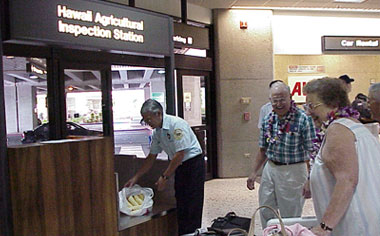
  • HDOA will establish an interisland quarantine that will restrict the movement of bees and bee equipment off of Oahu.

II.  Uninfested Islands


Extent of Infestation:


Surveys on Kauai, Molokai, Maui, and Hawaii have not found any varroa on those islands.  These survey results are in support that varroa has not yet made it to these islands despite being present on Oahu for at least a year.  These surveys have covered wide areas on the other islands but the number of surveyed hives needs to be increased in order to detect a recent infestation before it can spread. 


Goal:


Ensure that varroa does not become established on uninfested islands and detect an infestation early.


Objectives:


  1. Establish a quarantine to prevent mite movement off of Oahu   
  2. Detect new varroa incursions as early as possible before they have spread
  3. Eradicate new infestations


Strategy:


1.  Establish a quarantine to prevent mite movement off of Oahu.

  • HDOA will establish an interisland quarantine that will restrict the movement of bees and bee equipment off of Oahu.


2.  Detect new varroa mite incursions as early as possible before they have spread. 

  • It is essential that extensive periodic surveys are conducted to detect new infestations of varroa as early as possible before they have a chance to spread.
  • Beekeepers should sample their hives using the   “whole-of-colony acaricidal knockdown” technique as described in the Australian Veterinary Emergency Plan.  This involves placing a mesh covered sticky board on the hive floor and two Apistan strips in the brood nest.  The Apistan should be removed after 48 hours.  The sticky board can also be removed and checked for mites.  The honey can still be sold but will not be marketable as organic.
  • HDOA will provide the training, Apistan and sticky boards and monitor the results.
      (An alternative non-toxic sampling technique would be to use bottom sticky boards but this technique will be less effective in detecting low populations of mites.  We need to find effective non-toxic sampling techniques for organic honey producers)


3.  Eradicate new infestations.

  • All infested hives should be immediately destroyed (HDOA will contract with a Pest Control Company for the destruction of infested hives)
  • HDOA will work with beekeepers to sample all apiaries within 5 miles of the infested hive for varroa mites twice a year for one year using the “whole-of-colony acaricidal knockdown”.  The number of hives in an apiary that need to be sampled will vary with the size of the apiary and should be based on the Australian sampling requirements.