








|
Lyme Disease
(tick-borne borreliosis, Lyme arthritis)
What is Lyme disease?
Lyme disease is a tick-borne inflammatory illness caused by a
spirochete (a bacteria like organism) called Borrelia
burgdorferi. It is transmitted to humans by a specific type of
tick, known as the Ixodes tick, that commonly infests
wild rodents and deer. While Lyme disease is the most common tick-borne
illness reported on the mainland United States, Lyme disease is not
found in Hawaii. This is because we do not have the type of tick
responsible for transmitting this disease in Hawaii.
How do you get it?
It is believed that the Lyme disease is transmitted only after the
tick has bitten and fed on a person for several hours. Thus,
individuals who spend a lot of time outdoors where ticks are abundant
are at greatest risk of getting Lyme disease. There is no evidence that
the disease can be spread from person-to-person.
What are the symptoms of the disease?
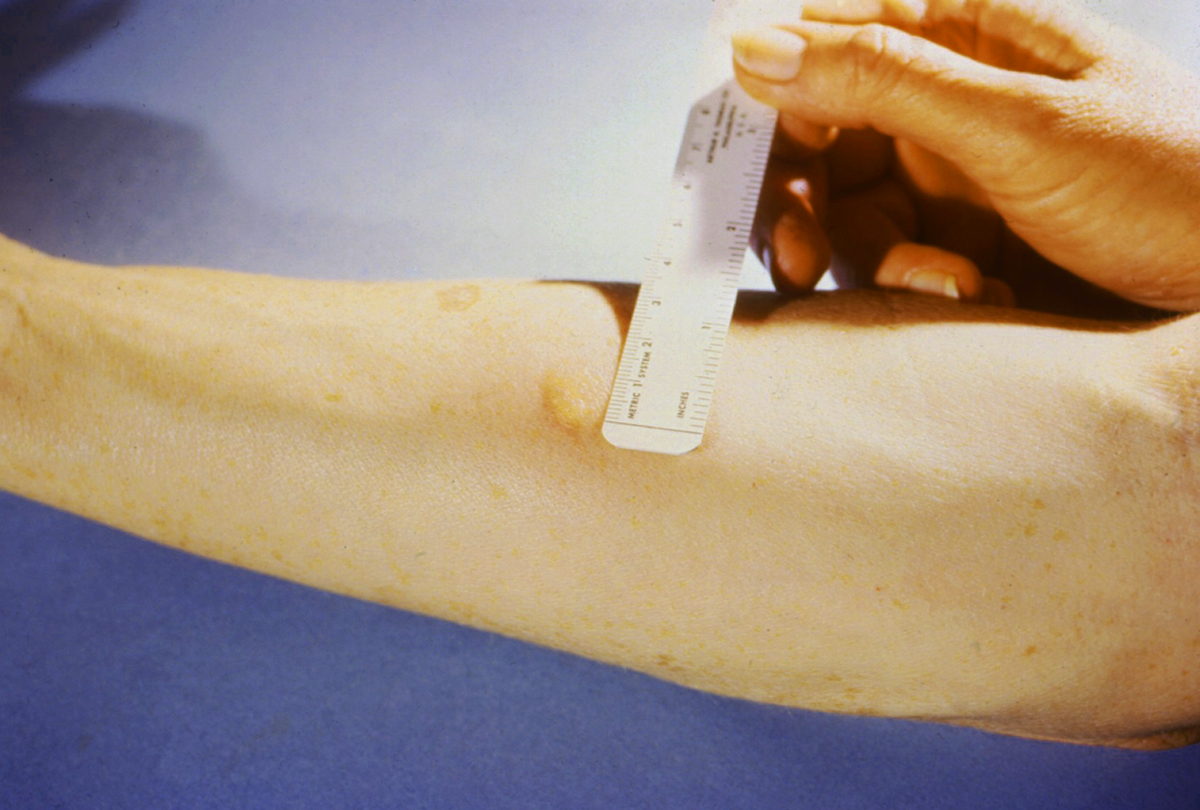
Lyme disease usually begins with the appearance of a distinctive
red, circular rash at or near the site of the tick bite. Fever,
headache, and fatigue occur at the same time as the rash, which may be
followed (weeks to months later) by neurologic, heart, or joint
abnormalities.
When do symptoms start?
The symptoms often begin within 1 month of being bitten by an
infected tick. It is very important to see a doctor promptly if a skin
rash develops after a recent tick bite.
What is the treatment for Lyme disease?
Lyme disease is treated with antibiotics prescribed by a
physician.
If you are bitten by a tick, how should it be removed?
To remove an attached tick, grasp it with tweezers as close as
possible to the skin surface, then pull up and out with a gentle,
steady pressure. If tweezers are not available, use fingers wrapped in
tissue paper or gloves; do not handle the tick with the bare hands. Be
careful not to squeeze, crush, or puncture the body of the tick as it
may contain the spirochete in its body fluids. After removing the tick,
thoroughly cleanse the area of the bite. Contact a doctor if all of the
body parts of the tick were not removed. It is important that ticks be
removed promptly when discovered. Do not attempt to remove ticks by
using Vaseline, lit cigarettes, alcohol, or other home remedies.
How do you keep from getting it?
Avoid tick-infested areas if possible. But when going into
tick-infested areas, wear clothing that covers the arms and legs. Tuck
trouser legs into socks, and shirts into trousers.
Try to prevent ticks from attaching by applying tick repellents
(i.e., DEET® or equivalent) to trouser legs and sleeves.
Check the entire body for attached ticks every 3 to 4 hours.
|